
December 2025
Game updates, a soil life public education project, and shipping for holiday print orders

Hi everyone!
Time is so weird. It’s already December but I still feel like Halloween was just a week ago. I guess it’s because I’ve been so deep into working on my microbe game. I’m certainly not complaining; it’s amazing to still have so much enthusiasm for this project after all this time and through all the challenges it has presented. Nothing else has kept me going like this for so long before!
Here’s what’s new since the last update.
Game Updates
New Creature: Testate Amoeba
In my previous post I mentioned biofilms, which are patches of bacteria and slime that have different effects on the player.
Real biofilms are like tiny fortresses that offer protective housing for the microbes living in them. Initially, biofilm bacteria were edible for the player but ignored by all other creatures in the game. This of course doesn’t make sense ecologically, since the player is a flagellate just like the others, and there’s no special reason they should be able to reach these bacteria when others can’t.. but sometimes it’s necessary to bend logic a little for the sake of game mechanics.
Next I decided to add new kind of creature that specialized in eating the biofilm bacteria, to add a little more competition and biodiversity. I’m actually not sure if this is true in real life, but it seems logical to me that a testate (shelled) amoeba with long thin “filose” pseudopods, or false feet, would be able to reach into the tunnels and crevices of a biofilm and pull out the bacteria hiding inside.
Creating the Amoeba
First I made separate drawings of an empty shell and an amoeba with no shell, then put both images on the game object so the amoeba could stretch out without warping the shell.
Real amoebas are usually colourless and can sometimes be difficult to see, but I decided this one could be colourful since it lives on the colourful biofilm bacteria. You are what you eat after all!


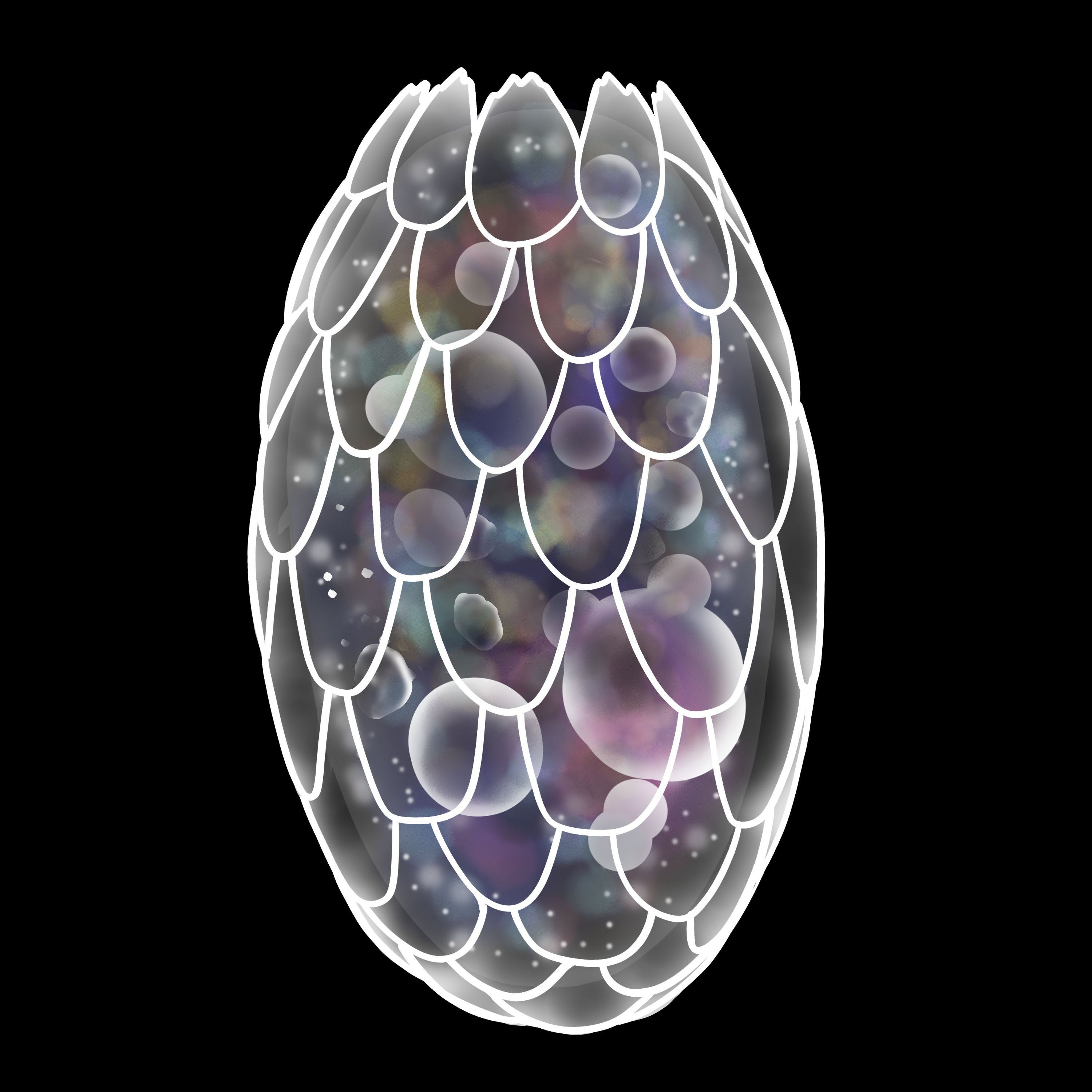
Then came a challenge. How on earth to animate this?
It took some tinkering, but I managed to set up an animation rig using “bones” and a script to control the pseudopods while the amoeba is moving and feeding.


Bones are attached strategically to the amoeba image so that when they move they pull sections of the artwork along with them to give the impression of long thread-like pseudopods reaching out from the shell. In real testate amoebas this type of pseudopod can also have branches, but trying to recreate that felt more complicated than it was worth.
In the video below you can see how the pseudopods stretch out and wander around as the amoeba moves. I sped part of the video up because the ameoba moves slowly, just like in real life. When disturbed, it quickly pulls them back into the shell and waits a few seconds before emerging again.
Once biofilm bacteria have appeared on the scene, testate amoebas move in and start searching for them. For now they just hang out on biofilm patches and graze on the bacteria as they spawn, and if the patch dies off they will leave and try to find a new one. They don’t have a very significant impact on the player at this stage, but they do add a little more life, variety, and competition into the scene. I plan to add more mechanics to them later on, and in particular have some fun ideas for how their empty shells could be useful to the player.
Containers and Frenzy Mode
As the soil ecosystem develops, clusters of mineral particles and organic matter called microaggregates start to appear. Sometimes these clusters have tiny hollow spaces inside, with special conditions that support certain types of bacteria that don’t thrive in out in the open.
In the Cellscape ecosystem, these bacteria are particularly delicious and nourishing, so as soon as they are exposed they get scooped up by hungry bacterivores, including the player. They can only be found hiding inside clusters, so how to get them?
Players will need to use the new shove ability (next section) to reach them, by cracking open the clusters they’re hiding in. The biggest, strongest clusters have the most bacteria hiding inside, and will need to be hit several times with full force to break apart.
I started with the drawings of individual mineral particles I made way back at the beginning, and rearranged those particles into layered clusters. I used a soft brush to paint in some fuzzy-looking material to represent humus and microbial “glues” that bind these special clusters together.
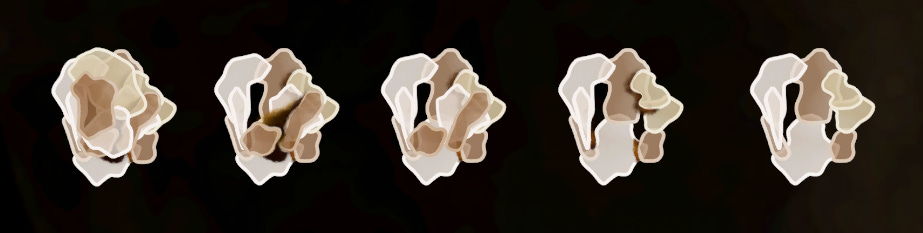
In Unity, I created a prefab for each unique cluster, then added physics and code to turn them into containers that react to being hit by the player’s shove ability.
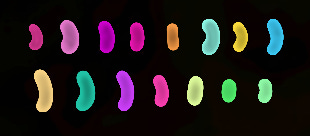
I also painted a bunch of new, brightly coloured bacteria and added them to a particle system below the cluster artwork. This gives a visual hint that there is something inside, and helps differentiate container clusters from normal ones.
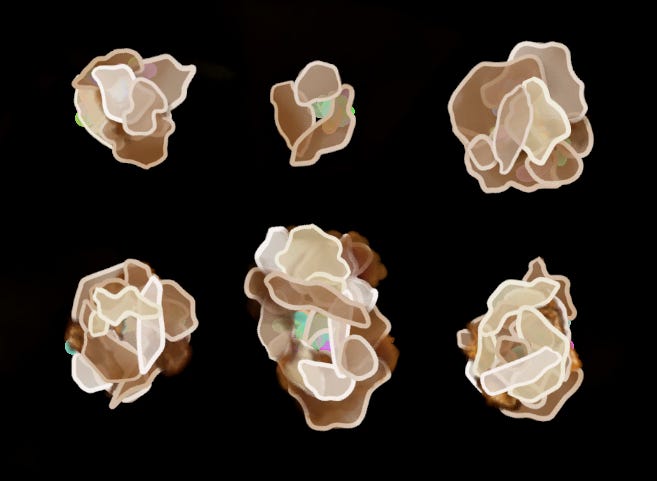
Once a cluster is cracked open and bacteria spill out, the player enters frenzy mode. Just like we as humans always seem to have room for dessert, these bacteria are so delicious the player can temporarily eat much more than normal.
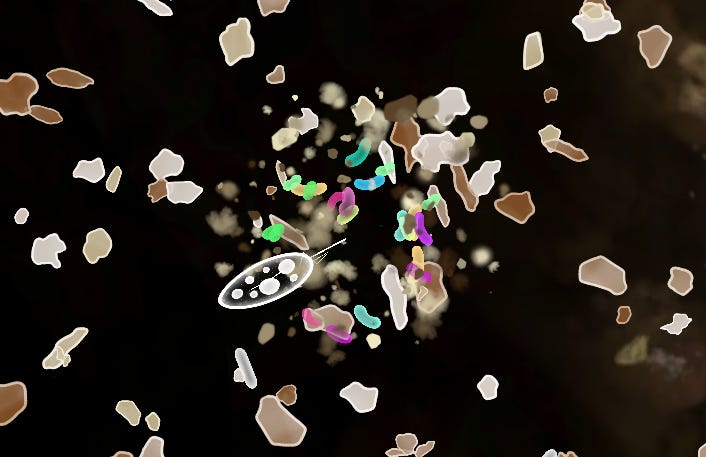
The player gets a few seconds to eat as much as possible without having to stop for divisions. The division progress bar will turn yellow to indicate when a frenzy is active. Afterwards the bar goes back to normal, and if the player ate enough, their next division can produce extra babies.
New Ability: Shove
Players now have the ability to pull back and release like a spring, sending other small creatures flying, and allowing them to smash open clusters to access the special bacteria hiding inside.
I made a little video to demonstrate:
It’s a lot of fun to boop other flagellates away, but it can be risky if there are predators lurking and suddenly you’re the only one left to chase!
The shove ability is of course not realistic for a flagellate, but it’s a ton of fun and a very worthwhile mechanic to have in the game.
What’s Next
Hunger
From the very beginning I’ve been unsure whether or not Cellscape should have a hunger mechanic. As things come together, I’m starting to see how it could fit into the game in a good way.
Hunger would add a new type of danger to watch out for, and it would push the player to keep moving and take risks in order to survive. Starvation would have gradually worsening negative effects on the player, such as slower movement, weakening shove force, and eventually game over.
A hunger need would also open up lots more possibilities for bonuses and special status effects, making the game more complex and challenging.
This will of course require a lot of balance and testing to make sure it’s actually a fun experience and not needlessly difficult or frustrating, but I do have a feeling it will be a good addition to the game.
Next Playtest
I’m eager to do another round of playtesting to make sure biofilms, shove, and container clusters are working well and that the gameplay feels good. I haven’t set a specific date for it yet, so be sure to join the Discord chat if you’re interested!
NM Healthy Soil Working Group Follow-Up
In my previous post I wrote about a project I did this year with the the New Mexico Healthy Soil Working Group.
Along with a commission to modify the soil food web illustration to represent a semi-arid environment, the organization licensed the line art separately so they could design their own posters and other educational materials with them.
I was delighted to hear back from Isabelle last week with an update on how they’ve used the artwork so far.
Here’s a photo of the poster they made, with a comment from Isabelle:
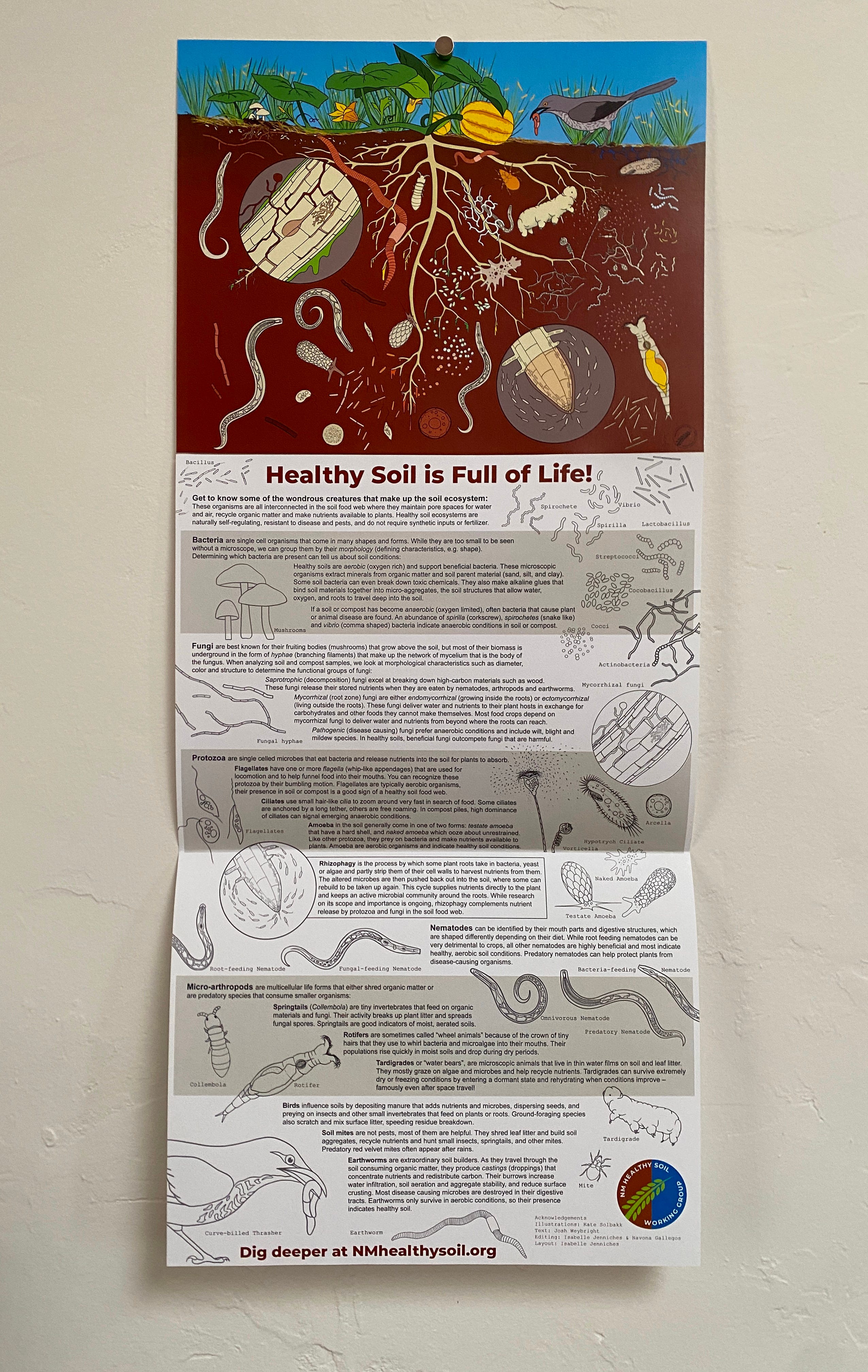
“The poster was a hit at the REGENERATE Conference in Santa Fe! We also had a microscope and monitor set up, showing lots of soil life in samples of biologically rich Johnson-Su compost. This was a great combo.
We have many more ideas how to use the images to educate about the soil food web --we want to make a kids version, for example.”
- Isabelle Jenniches
It’s tricky to fit so many different pieces into one big picture while keeping it readable and attractive, and they did an absolutely fantastic job with it! The poster is beautiful and approachable while delivering tons of good information about soil life.
They’re also using the artwork on their blog, which you can find here:
https://www.nmhealthysoil.org/2025/11/12/healthy-soil-is-full-of-life/
Thanks again to Isabelle and the NM Healthy Soil Working Group. I’m so proud to have been part of this!
Holiday Print Orders
It’s already too late for international deliveries to arrive before December 25th, but if you’re in the United States you can order until December 6th. You can find INPRNT’s holiday shipping info here.
I’ll admit this has been a low-income year for me since I’ve been spending almost all my time bringing Cellscape to life. If you like what I do and have ever considered purchasing a print or upgrading your subscription here, it would make an especially big difference for me if you decide to do it now, if you have the means.
Thank you so much for the support and for believing in me!
That’s all for now. Thank you so much for being here! I’ll be back soon with more updates.
Wishing you all the best,
Kate